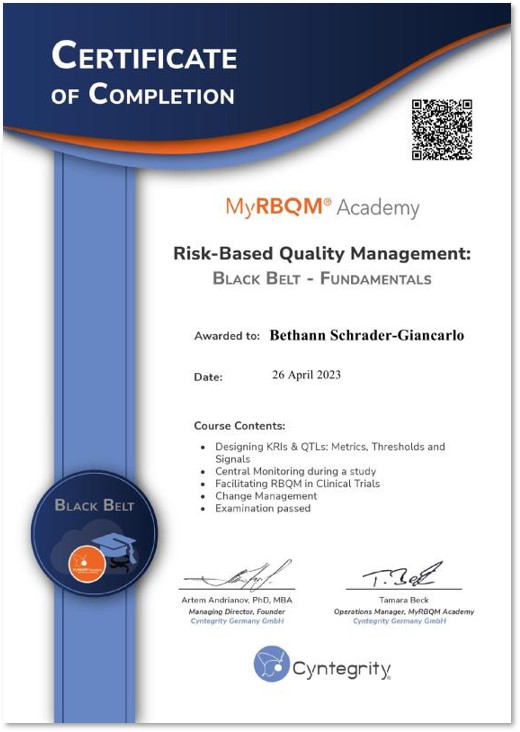
RBQM Essentials Black Belt – iLT for Teams

Designed for professionals leading RBQM implementation, oversight strategy, and operational governance across clinical trial organizations.

Instructor-Led Virtual Training
Four interactive 2-hour workshops
Aligned with ICH E6(R3) / E8(R1)
Focused on RBQM governance and implementation leadership

Where this module fits

This advanced instructor-led module is the leadership level of the MyRBQM Academy pathway. It builds on White Belt foundational understanding and Green Belt operational application, focusing on RBQM governance, implementation leadership, and cross-functional oversight.

Participants explore how to lead the RBQM rollout, facilitate structured risk management activities, support the adoption of centralized monitoring, and guide teams in applying proportionate oversight across studies and functions.

The module is designed for experienced professionals who are expected to support organizational RBQM maturity, influence stakeholder alignment, and help embed risk-based decision-making into clinical trial operations.

It is best suited for professionals responsible for RBQM implementation, oversight governance, cross-functional alignment, inspection readiness, and sustainable adoption under ICH E6(R3) and E8(R1).

What you will be able to do

  • Design and operationalize KRIs, QTLs, metrics, thresholds, and escalation approaches within RBQM programs
  • Lead centralized monitoring and risk-based oversight activities across active clinical trials
  • Facilitate structured risk identification, evaluation, mitigation, and governance processes across functions
  • Support organizational RBQM implementation and sustainable operational adoption
  • Apply change management principles to improve stakeholder alignment and reduce implementation resistance
  • Guide cross-functional teams in risk-based decision-making, issue escalation, and oversight documentation
  • Strengthen inspection readiness through proportionate oversight rationale and traceable decision practices
  • Contribute strategically to RBQM governance, operational maturity, and continuous quality improvement initiatives

Outcomes for Individuals and Teams

For Individual Learners

  • Strengthen RBQM leadership capability
  • Improve oversight and governance decision-making
  • Lead cross-functional RBQM initiatives
  • Support inspection readiness activities
  • Improve stakeholder alignment and escalation practices
  • Advance from operational execution to strategic oversight

For Enterprise Teams

  • Build sustainable RBQM governance capability
  • Improve consistency across oversight functions
  • Strengthen cross-functional collaboration
  • Support organizational RBQM rollout initiatives
  • Improve inspection readiness and traceability
  • Drive more consistent risk-based decision-making

Who this is for

  • RBQM Leads and Risk Managers
  • Study Managers and Trial Managers
  • Centralized Monitoring Leads
  • Medical Monitors and Safety Leads
  • Lead Data Managers and Clinical Data Leaders
  • Lead Biostatisticians and Statistical Monitoring Teams
  • QA / GCP Quality and Inspection Readiness Professionals
  • Clinical Operations leadership roles
  • Professionals responsible for KRIs, QTLs, and oversight governance
  • Teams leading or supporting RBQM implementation and organizational rollout
  • Sponsor and CRO stakeholders involved in operational oversight and risk governance

Typical use cases in practice

This advanced Black Belt program is typically used by organizations preparing to lead or scale RBQM implementation across studies, functions, or global clinical trial programs.

It supports professionals responsible for RBQM governance, centralized monitoring and oversight, risk escalation, organizational alignment, and inspection-readiness activities under ICH E6(R3) and E8(R1).

The program is commonly used to strengthen collaboration across Clinical Operations, QA, Medical Monitoring, Data Management, Biostatistics, and Centralized Monitoring functions where consistent risk-based oversight and decision-making are required.

Organizations also use the Black Belt pathway to develop internal RBQM facilitators, implementation leads, and change agents who can support sustainable operational adoption and continuous improvement initiatives.

Dedicated sponsor and CRO workshops can incorporate organization-specific studies, operational scenarios, governance structures, KRIs, QTLs, and oversight workflows to increase direct operational relevance across teams.

Delivery and rollout options

• Instructor-led Black Belt training delivered through four interactive 2-hour live workshops

• Focused on RBQM governance, implementation leadership, oversight strategy, and cross-functional collaboration

• Includes practical discussions on KRIs, QTLs, centralized monitoring, escalation pathways, and risk-based oversight

• Led by experienced RBQM practitioners with sponsor and CRO implementation experience

• Certificate awarded upon successful completion

• Includes workshop materials and implementation-oriented reference content

Available for:

• Open enrollment virtual instructor-led sessions

• Dedicated sponsor and CRO team workshops

• Cross-functional RBQM capability-building initiatives

• Customized in-person and enterprise rollout programs

Dedicated organizational sessions can incorporate sponsor-provided studies, operational scenarios, and organization-specific RBQM processes.

Workshop interaction guidance:

Minimum 3 participants recommended.
Recommended maximum: 8 participants.
For larger groups or enterprise rollout discussions, please contact us.

Recommended prerequisite:

RBQM Essentials White Belt and Green Belt completion is recommended before enrolling in Black Belt. Participants should already have foundational RBQM understanding and practical experience with risk-based oversight concepts.


Sneak Peek

Price range: €875,00 through €6.475,00

Need Multiple Seats?

AI Use in Clinical Trials Is Increasing.
So Are Regulatory Expectations.

Regulators expect controlled, documented, and reviewable AI use. Prepare your teams to apply AI within GCP and computerized system requirements.